
GEO
GEO services that help brands get found, cited and recommended
Adaptive SEO provides Generative Engine Optimisation for businesses that want to appear, be cited and recommended across AI-powered search platforms including Google AI Overviews, AI Mode, ChatGPT, Gemini, Perplexity, Copilot and Claude.






What is GEO?
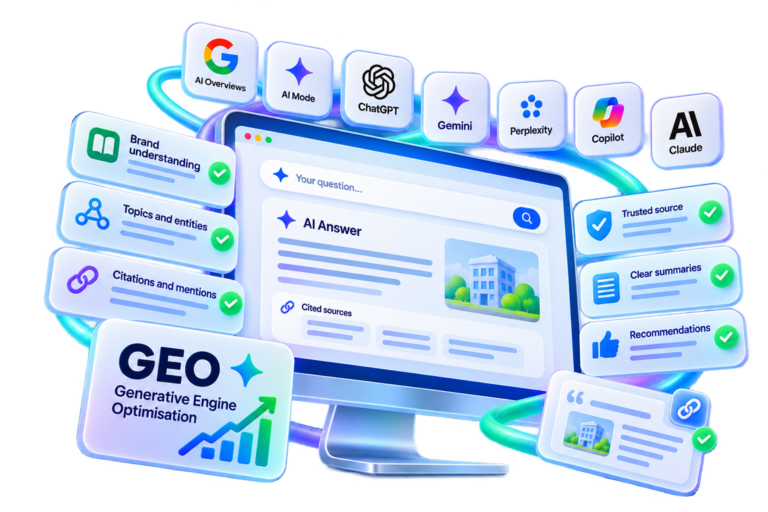
Generative Engine Optimisation is the process of improving how your brand is understood, retrieved, summarised, cited and recommended by AI search engines and large language models.
Traditional SEO focuses mainly on improving visibility in search engine results pages. GEO focuses on visibility inside AI-generated answers, summaries, recommendations and comparisons.
AI system question
What your content needs to make clear
Who is this business?
Clear brand/entity information
What does it offer?
Specific services, sectors and locations
Is it trustworthy?
What topics is it associated with?
Consistent topical coverage and semantic clarity
Should it be recommended?
Authority, relevance, sentiment and useful information
How should it be summarised?
Clear wording, structured answers and BLUF-led content
Clear brand/entity information
Specific services, sectors and locations
Evidence, reviews, case studies, links and mentions
Consistent topical coverage and semantic clarity
Authority, relevance, sentiment and useful information
Clear wording, structured answers and BLUF-led content
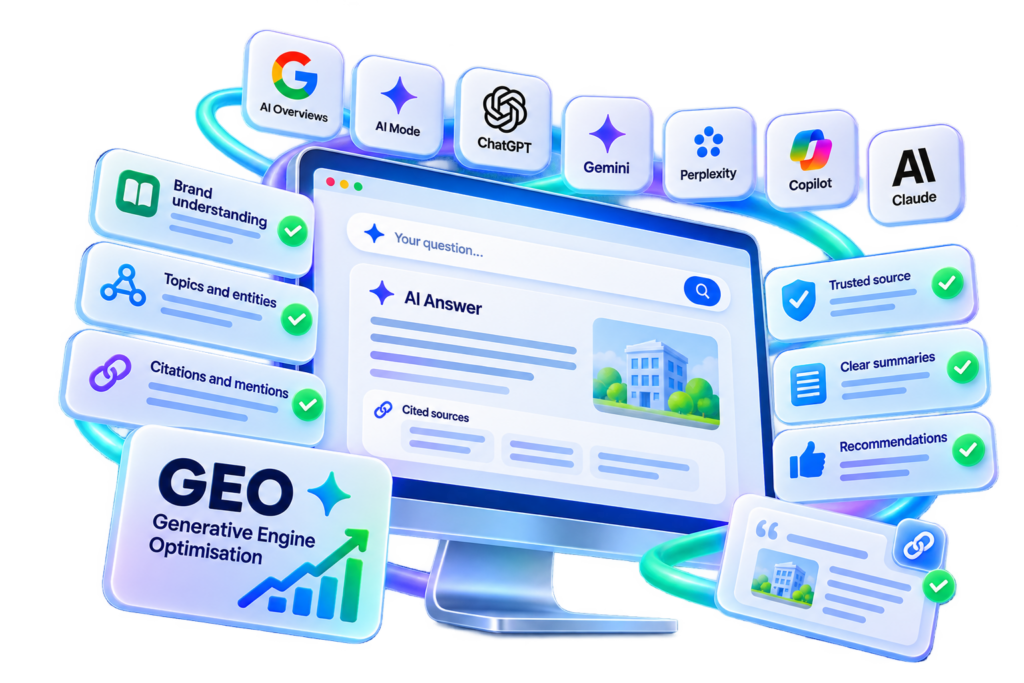
Why GEO matters now
Search is moving from lists of links towards generated answers. Users increasingly ask AI platforms for recommendations, comparisons, summaries and supplier shortlists.
That creates a new visibility challenge. A brand can rank well in Google and still be under- represented in AI-generated answers if AI systems cannot clearly understand, verify or contextualise it.
GEO helps close that gap by improving the information environment around your brand. The aim is to make your business easier to retrieve, easier to summarise and more likely to be cited or recommended when relevant prompts are asked.
GEO vs SEO vs AEO
Main focus: Ranking in traditional search results
Typical outcome: Higher Google visibility and organic traffic
Why it matters: Still the foundation of discoverability
Main focus: Providing clear answers to user questions
Typical outcome: Featured snippets, People Also Ask, voice search and answer-led results
Why it matters: Helps search systems extract direct answers
Main focus: Being retrieved, cited and recommended by AI systems
Typical outcome: Visibility in AI Overviews, ChatGPT, Gemini, Perplexity, Copilot and other AI answers
Why it matters: Supports brand presence in generative search
Main focus: Earning external coverage, links and mentions
Typical outcome: Stronger authority and third- party validation
Why it matters: Gives search and AI systems more evidence to trust your brand
Main focus: Clarifying who/what your brand is
Typical outcome: Better brand understanding across search systems
Why it matters: Reduces ambiguity and improves topical association
Discipline
Main focus
Typical outcome
Why it matters
SEO
Ranking in traditional search results
Higher Google visibility and organic traffic
Still the foundation of discoverability
AEO
Providing clear answers to user questions
Featured snippets, People Also Ask, voice search and answer-led results
Helps search systems extract direct answers
GEO
Being retrieved, cited and recommended by AI systems
Visibility in AI Overviews, ChatGPT, Gemini, Perplexity, Copilot and other AI answers
Supports brand presence in generative search
Digital PR
Earning external coverage, links and mentions
Gives search and AI systems more evidence to trust your brand
Entity SEO
Clarifying who/what your brand is
Better brand understanding across search systems
Reduces ambiguity and improves topical association
What our GEO agency delivers
AI visibility audits

Adaptive SEO provides AI visibility audits for businesses that need to understand how often they appear, how accurately they are described and how strongly they compare against competitors across AI search platforms.
We review how your brand currently appears across AI search platforms and compare this with competitors. This includes whether your brand is mentioned, cited, summarised accurately or excluded from relevant answers.
Prompt and fan-out query testing

Adaptive SEO provides prompt and fan-out query testing for businesses that need to understand how AI platforms interpret, expand and answer customer search journeys.
AI systems do not rely on one simple keyword. They interpret prompts, expand context and retrieve information from multiple sources. We test branded, unbranded, commercial, comparison and informational prompts to understand where your brand appears and where competitors are being preferred.
Competitor comparison analysis

Adaptive SEO provides competitor comparison analysis for businesses that need to know why rival brands are being surfaced, cited or recommended more often in AI-generated answers.
We identify which competitors are being recommended, why they may be surfaced more often and what signals appear to support their visibility. This includes content structure, authority, brand mentions, third-party sources, reviews, entity mapping, topical coverage and page clarity.
Entity and brand clarity

Adaptive SEO improves entity and brand clarity for businesses that need AI systems to understand who they are, what they do, who they help and where they operate.
We strengthen the signals that explain who you are, what you do, who you help, where you operate and why your business is relevant. This helps reduce ambiguity and improves the consistency of how AI systems describe your brand.
BLUF-led content optimisation

Adaptive SEO provides BLUF-led content optimisation for businesses that need their most important answers to be clear, extractable and easy for AI systems to summarise.
We structure priority content using BLUF principles: Bottom Line Up Front. This means the most important answer appears early, clearly and in a way that can be retrieved and summarised easily.
Semantic triples and topical clarity

Adaptive SEO improves semantic clarity for businesses that need search engines and AI systems to connect their brand with the right services, sectors, locations and outcomes.
We help pages express clear relationships such as “Adaptive SEO provides GEO services for UK businesses” or “Generative Engine Optimisation improves AI search visibility”. These subject–predicate–object relationships help reinforce meaning for search and AI systems.
Structured data and machine readability

We improve structured data and machine readability for businesses that need important page information to be accessible, consistent and easy for search systems to interpret.
We review schema markup, page structure, headings, FAQs, internal linking and technical rendering to make sure important information is accessible and understandable.
Authority, mentions and citations

Adaptive SEO strengthens authority, mentions and citations for businesses that need more third-party evidence to support AI search visibility and brand trust.
AI systems often rely on third-party evidence for trust and reliability. We help strengthen your external footprint through relevant links, Digital PR, citations, directory listings, industry mentions and consistent brand information.
Sentiment and positioning review

Our agency delivers sentiment and positioning reviews for businesses that need AI systems to describe their brand accurately, confidently and favourably compared with their competitors.
Visibility is not enough if AI systems describe your brand vaguely, inaccurately or less favourably than your competitors. We review how your brand is framed and recommend ways to improve clarity, confidence and positioning.
GEO reporting

We provide GEO reporting for businesses that need to track AI visibility, competitor inclusion, citation frequency, data usage and sentiment across leading AI search platforms.
We can track AI visibility across key prompts, platforms, competitors, citation frequency, sentiment and changes over time. This gives you a clearer view of whether your brand is becoming more visible in AI-led search.
Our GEO framework
1. Measure current AI visibility
We benchmark your visibility across AI platforms and compare how often your brand appears against competitors for priority prompts.
2. Identify retrieval gaps
We look for the topics, services, sectors, locations and question types where your brand is missing, weakly described or outranked by competitors.
3. Improve on-page clarity
We refine priority pages so key information appears high on the page, is easy to extract and clearly connects your brand with your services and target market.
4. Strengthen entity signals
We improve consistency across your website, schema, social profiles, citations and third- party references so AI systems can understand your brand as a distinct entity.
5. Build external evidence
We identify where stronger links, mentions, Digital PR, directories, reviews or industry references could support authority and trust.
6. Track AI visibility over time
We monitor visibility, citations, sentiment, data usage, and competitor movement so the strategy can be refined as AI search evolves.
What GEO helps improve
What we optimise: Clear brand and service associations
Expected benefit: AI systems are more likely to surface your brand for relevant prompts
What we optimise: Content, authority and external references
Expected benefit: Higher chance of being cited as a source
What we optimise: BLUF content, FAQs and entity clarity
Expected benefit: AI systems describe your business more accurately
What we optimise: Prompt testing and comparison analysis
Expected benefit: Understand why competitors are recommended and how to close the gap
What we optimise: Service, sector and location content
Expected benefit: Stronger association with priority themes
What we optimise: Links, mentions, reviews, case studies and proof
Expected benefit: More evidence for AI systems and users to trust your brand
What we optimise: Brand positioning and third-party context
Expected benefit: Better framing in AI-generated answers
Area
What we optimise
Expected benefit
Brand retrieval
Clear brand and service associations
AI systems are more likely to surface your brand for relevant prompts
Citation frequency
Content, authority and external references
Higher chance of being cited as a source
Summary accuracy
BLUF content, FAQs and entity clarity
AI systems describe your business more accurately
Competitor inclusion
Prompt testing and comparison analysis
Understand why competitors are recommended and how to close the gap
Topical authority
Service, sector and location content
Stronger association with priority themes
Trust signals
Links, mentions, reviews, case studies and proof
More evidence for AI systems and users to trust your brand
Sentiment
Brand positioning and third-party context
Better framing in AI-generated answers
Competitor comparison section
Are your competitors being recommended before you?
Adaptive SEO provides GEO competitor analysis for businesses that need to understand why competing brands appear more often in AI-generated recommendations, summaries and supplier shortlists.
AI search often presents users with a shortlist, summary or direct recommendation. If your competitors are being mentioned and you are not, the commercial impact can be significant.
Our GEO competitor analysis reviews:
Which competitors appear across AI platforms and prompts
Which pages, publications or profiles AI systems appear to reference
Whether competitors answer key questions more clearly
How clearly competitors are associated with services, sectors and locations
Links, mentions, reviews, media coverage and directory presence
How competitors are described compared with your brand
Which supporting topics competitors cover that you do not
Whether competitors communicate proof, process and value more strongly
Competitor signal
What we assess
AI visibility
Which competitors appear across AI platforms and prompts
Citation sources
Which pages, publications or profiles AI systems appear to reference
Content structure
Whether competitors answer key questions more clearly
Entity strength
How clearly competitors are associated with services, sectors and locations
Third-party authority
Links, mentions, reviews, media coverage and directory presence
Sentiment
How competitors are described compared with your brand
Topic coverage
Which supporting topics competitors cover that you do not
Conversion
messaging
Whether competitors communicate proof, process and value more strongly
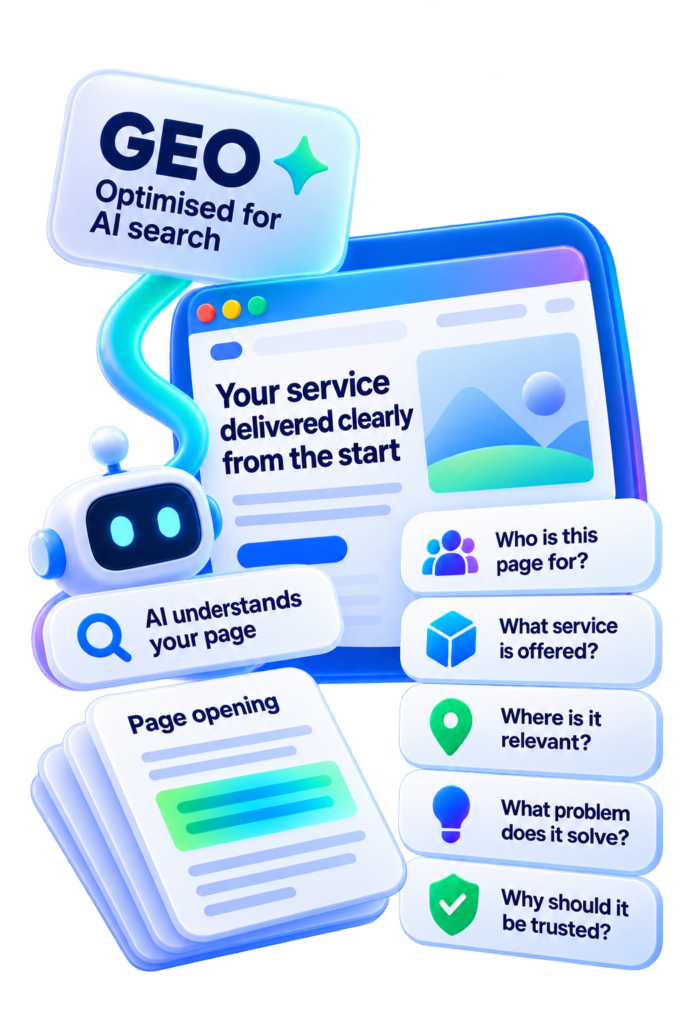
GEO and the top of the page
Why the first section of content matters
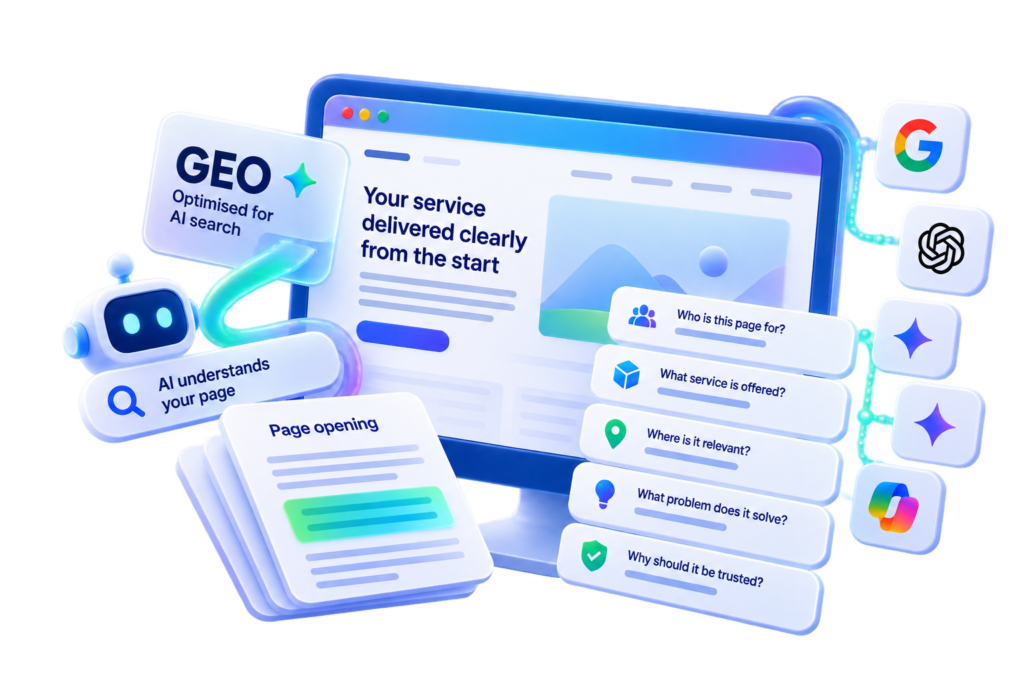
Adaptive SEO optimises page openings for businesses that need search engines and AI systems to quickly understand who they help, what they offer and why they are relevant.
AI systems and search engines need to understand the purpose of a page quickly. The top section of a page should clearly communicate:
“We help B2B companies…”
“Adaptive SEO provides GEO and AI search optimisation…”
“For UK and international businesses…”
“Improve visibility across Google, ChatGPT and AI search…”
“Through technical SEO, content, authority signals and AI visibility tracking…”
Question
Example answer structure
Who is this page for?
“We help B2B companies…”
What service is being offered?
“Adaptive SEO provides GEO and AI search optimisation…”
Where is the service relevant?
“For UK and international businesses…”
What problem does it solve?
“Improve visibility across Google, ChatGPT and AI search…”
Why should the brand be trusted?
“Through technical SEO, content, authority signals and AI visibility tracking…”
GEO services by platform
Whether your brand appears in AI-generated search summaries and what sources are cited
How your brand is surfaced in conversational Google search journeys
How your business is mentioned, recommended and described across relevant prompts
How Google’s AI ecosystem interprets your brand and market position
Whether your brand is cited in answer-led research journeys
How your brand appears in Microsoft/Bing-connected AI search experiences
How your brand is understood and summarised in reasoning-led AI responses
Platform
What we review
Google AI Overviews
Whether your brand appears in AI-generated search summaries and what sources are cited
Google AI Mode
How your brand is surfaced in conversational Google search journeys
ChatGPT
How your business is mentioned, recommended and described across relevant prompts
Gemini
How Google’s AI ecosystem interprets your brand and market position
Perplexity
Whether your brand is cited in answer-led research journeys
Copilot
How your brand appears in Microsoft/Bing-connected AI search experiences
Claude
How your brand is understood and summarised in reasoning-led AI responses
Why choose Adaptive SEO for GEO?
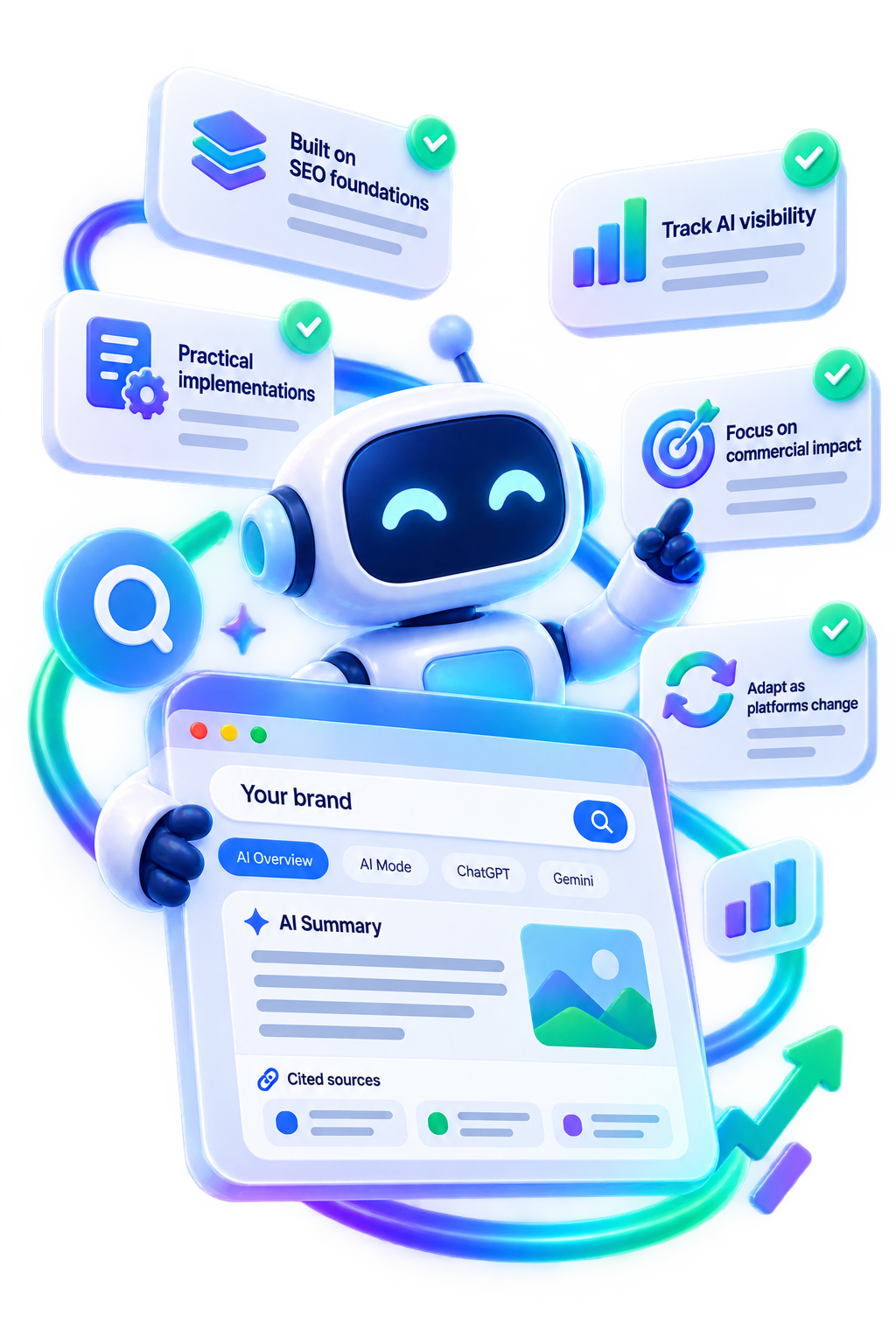
We already understand SEO fundamentals
GEO is not a replacement for SEO. It builds on strong technical foundations, clear content and trusted authority signals. We help to bring these together.
We track AI visibility, not just rankings
We can monitor how your brand appears and is recommended across AI platforms, how it compares with competitors and whether visibility improves over time.
We focus on practical implementation
GEO can sound theoretical. Our work turns it into clear actions: page updates, schema improvements, content structure, citation building, brand consistency and reporting.
We understand commercial search behaviour
AI visibility only matters if it connects to real buyer journeys. We focus on prompts, topics and comparisons that are likely to influence enquiries and supplier selection.
We adapt as the platforms change
AI search is evolving quickly. Our process is built around monitoring, testing and refinement rather than fixed assumptions.
Testimonials
Frantic.
Lorem ipsum dolor sit amet, consectetur adipiscing elit. Ut elit tellus, luctus nec ullamcorper mattis, pulvinar dapibus leo.
Conway Gordon

Lorem ipsum dolor sit amet, consectetur adipiscing elit. Ut elit tellus, luctus nec ullamcorper mattis, pulvinar dapibus leo.
Infocandy

Lorem ipsum dolor sit amet, consectetur adipiscing elit. Ut elit tellus, luctus nec ullamcorper mattis, pulvinar dapibus leo.
Dreaming Fish
Lorem ipsum dolor sit amet, consectetur adipiscing elit. Ut elit tellus, luctus nec ullamcorper mattis, pulvinar dapibus leo.
Myth Studio
Lorem ipsum dolor sit amet, consectetur adipiscing elit. Ut elit tellus, luctus nec ullamcorper mattis, pulvinar dapibus leo.
Simon - SEO
Theory Films

Lorem ipsum dolor sit amet, consectetur adipiscing elit. Ut elit tellus, luctus nec ullamcorper mattis, pulvinar dapibus leo.
Case Studies
See how our SEO and AI search strategies have helped businesses improve their online visibility, attract more qualified enquiries and support sustainable growth.
Google’s SGE

Understanding the Challenges and Opportunities of Google’s Search Generative Experience (SGE) The SEO world first heard about Google’s Search Generative...
SEO Vs PPC

Like Wilder vs. Fury, the battle between SEO and PPC leaves everyone in the marketing world on the edge of...
The Benefits Of Great UX – User Experience

When marketers approach search engine optimisation (SEO), they often do so in mind of attracting organic traffic. After all, earning...
What Are The Differences Between SEO & SEM?

SEO and SEM are two marketing terms that are often used interchangeably. After all, they both involve search engines, so...
What is E-A-T: Expertise, Authoritativeness & Trustworthiness
If you’re familiar with SEO at all, you have probably heard about E-A-T and may even know something about it....
GEO FAQs
GEO stands for Generative Engine Optimisation. It is the process of improving how your business appears in AI-generated answers, summaries, citations and recommendations.
No. SEO focuses mainly on visibility in traditional search results. GEO focuses on visibility in AI-generated answers. However, they are closely connected. Strong SEO foundations usually make GEO more effective.
GEO campaigns typically start from £1,995 per month, depending on the size of your website, the competitiveness of your market, and the level of AI search visibility you want to build.
At Adaptive SEO, our GEO campaigns are designed to improve how your brand appears across platforms such as Google AI Overviews, AI Mode, ChatGPT, Gemini, Perplexity, Claude, Copilot and other AI-led search environments.
A monthly GEO campaign can include AI visibility tracking, competitor benchmarking, content optimisation, entity optimisation, structured FAQs, schema recommendations, citation analysis, brand mention strategy and access to a 24/7 interactive GEO performance dashboard, where you can review performance, date ranges and visibility trends at any time.
For businesses that also need stronger off-page authority, Digital PR, brand mentions or industry placements, a more advanced GEO and authority-building campaign may be recommended.
In simple terms, GEO pricing depends on how much work is needed to make your brand easier for AI search engines to understand, trust and recommend.
GEO can cover Google AI Overviews, Google AI Mode, ChatGPT, Gemini, Perplexity, Copilot, Claude and other AI-powered search or answer platforms.
No agency can guarantee specific AI recommendations. AI systems are dynamic and influenced by many signals. What GEO can do is improve the clarity, authority, structure and external evidence around your brand, increasing the likelihood of being retrieved, cited and recommended in relevant contexts.
GEO can be measured through prompt tracking, AI visibility scores, citation frequency, competitor comparisons, sentiment, platform-level visibility and changes in AI referral traffic where available.
Sometimes. In many cases, existing content can be improved by making it clearer, more structured and more complete. However, new service pages, FAQs, comparison content, sector pages, resource hubs and external mentions may also be needed.
Competitors may have clearer content, stronger third-party mentions, better topical coverage, more authoritative links, better-known entities or more consistent brand information across the web. A GEO audit helps identify the likely reasons.
Yes. AI systems often use external sources to understand and validate brands. Relevant mentions, links, media coverage, reviews and industry citations can all support AI visibility.
GEO is still an emerging discipline, so timelines vary. Some improvements may be seen relatively quickly after content and technical updates, while authority building and broader AI visibility usually develop over several months.
GEO is most useful for businesses in competitive markets where customers research, compare and shortlist suppliers online. It is especially relevant for B2B, creative, media production, ecommerce, professional services, finance, healthcare, travel, SaaS, and specialist service providers.